
Fall Prevention Exercises to Build Steadier Steps
A missed step at the kerb, a turn taken too quickly in the kitchen, or getting up after sitting for a while can be enough to expose a loss of balance. Fall prevention exercises are not about making every movement cautious. They are about building the strength, control and confidence to move through everyday life more safely.
Falls can happen at any age, but the risk often rises when leg strength, joint movement, balance or reaction time is reduced. Pain, a recent operation, medication changes, poor footwear and conditions affecting the nerves or inner ear can all play a part. The right exercises can help, but they should match your current ability and any health conditions you have.
Why strength and balance work together
Balance is not simply a skill you either have or do not have. Your body constantly uses information from your eyes, feet, joints and inner ear to keep you upright. Your muscles then need to react quickly enough to keep your centre of weight over your feet.
This is why a balance-only approach is often not enough. Stronger calves, thighs, hips and core muscles make it easier to stand up from a chair, correct a wobble and manage stairs. Regular practice also improves confidence, which matters because fear of falling can lead people to move less. Less activity can then reduce strength further.
The best fall prevention exercise programme usually combines controlled strength work with balance tasks that are challenging but safe. Start with support nearby, progress gradually and focus on quality rather than rushing through repetitions.
Before you start fall prevention exercises
Choose a clear space with a firm, non-slip floor. Wear supportive shoes rather than slippers, socks or loose footwear, and use a stable kitchen worktop or the back of a heavy chair for support. Keep a mobile phone nearby if you are exercising alone.
You should be able to exercise with mild muscular effort, but stop if you develop chest pain, severe breathlessness, faintness, new weakness, or pain that is sharp or worsening. If you have had a recent fall, surgery, a fracture, a neurological condition, significant joint pain or episodes of dizziness, it is sensible to seek individual advice before progressing your exercises.
Aim to complete these movements two to three times a week at first. Balance practice can be done more often in short sessions, provided you feel safe and well.
Six practical exercises for steadier movement
1. Sit-to-stand
This is one of the most useful movements for daily independence. It strengthens the thighs and hips, which are needed for rising from a chair, using the toilet and getting in and out of a car.
Sit towards the front of a firm chair with your feet hip-width apart and flat on the floor. Lean forwards slightly from the hips, push through your feet and stand tall. Lower yourself back down slowly and with control. Use the armrests at first if needed, then reduce hand support as you become stronger.
Start with 6 to 10 repetitions. The goal is not to drop quickly into the chair but to control the lowering phase, as this builds useful leg strength.
2. Heel raises
Your calf muscles help control your ankle when you walk and respond to small changes in ground level. Improving their strength can make your steps more stable.
Stand facing a worktop and hold it lightly. Rise onto the balls of both feet, pause for a second, then lower your heels slowly. Keep your knees straight but not locked and avoid leaning heavily into your hands.
Try 8 to 12 repetitions. Once this feels comfortable, progress by using less hand support or taking more of your weight through one leg at a time. Only do this if you can remain steady.
3. Side leg lifts
The muscles at the outside of the hip help keep the pelvis level when you walk or stand on one leg. When they are weak, turning, stepping sideways and climbing stairs can feel less controlled.
Hold a worktop with one hand and stand tall. Keeping the knee straight and toes facing forwards, move one leg out to the side without leaning your trunk. Bring it back slowly. Complete 8 to 12 repetitions on each side.
You should feel this around the side of the standing or moving hip, not in the lower back. Smaller, controlled movements are more effective than swinging the leg high.
4. Tandem stance
Tandem stance challenges balance by narrowing your base of support. It is a useful step between standing with your feet apart and practising more demanding single-leg balance.
Stand near a worktop. Place one foot directly in front of the other, as though standing on a line, while keeping a hand close to support. Hold for 10 to 20 seconds, then swap which foot is in front.
If placing the feet heel-to-toe feels too difficult, leave a small gap between them. As your balance improves, use lighter fingertips on the worktop rather than letting go completely. Safety comes before challenge.
5. Weight shifts
Many stumbles happen during a transfer of weight, such as reaching for a cupboard or stepping around furniture. Weight shifts train this movement in a controlled way.
Stand with your feet hip-width apart and hold a worktop if required. Slowly move your weight to the right leg without lifting the left foot, then return to the middle and repeat to the left. Keep your upper body upright and let the movement come from your hips and ankles.
Practise 10 shifts each way. When this becomes easy, you can shift forwards and backwards gently, keeping both feet on the floor. This should feel controlled, not like you are trying to catch yourself.
6. Supported marching
Marching improves hip strength, coordination and the ability to briefly stand on one leg during walking. It also highlights whether one side feels less steady than the other.
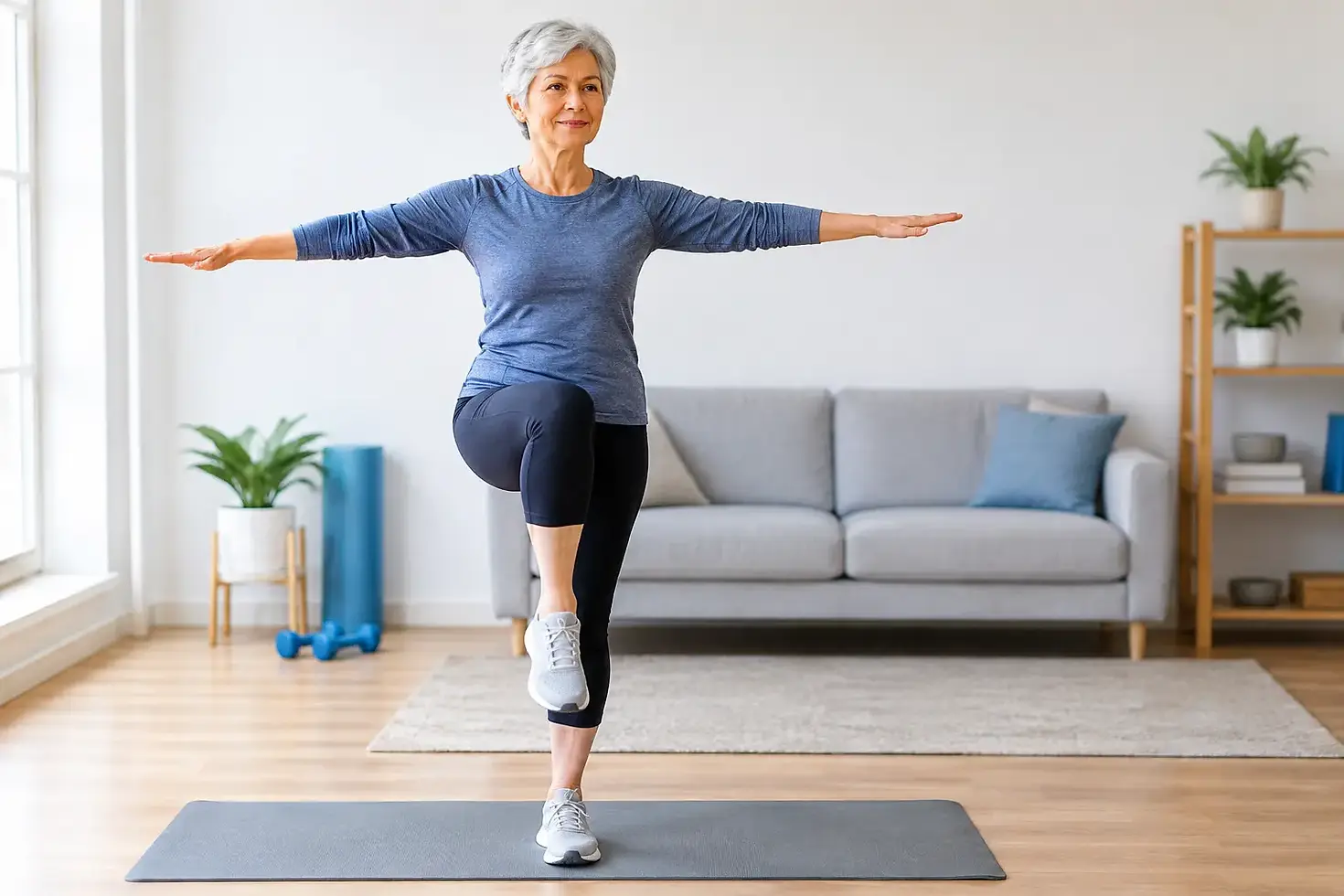
Stand at a worktop and lift one knee slowly, then lower the foot with control before lifting the other knee. Keep your posture tall and avoid rushing. Begin with 10 marches on each side.
As you improve, use only one hand for support or lift each knee a little higher. Do not close your eyes or practise without support simply to make the exercise harder. A sensible progression is one that challenges you while allowing safe control.
Make the exercises part of your week
Consistency is more valuable than an occasional long session. You might practise sit-to-stands before lunch, heel raises while waiting for the kettle and tandem stance at the worktop once or twice a day. Linking exercises to familiar routines makes them easier to keep up.
Walking, strength training and activities such as tai chi can also support balance, depending on your starting point. However, exercise alone cannot remove every risk. Good lighting, clear walkways, secure rugs, appropriate footwear and up-to-date eyesight checks all make a practical difference at home.
Keep track of what changes. You may notice that you can rise from a chair with less effort, turn with more control or walk further without feeling unsteady. If an exercise leaves you sore for more than a day, reduce the repetitions or range of movement next time. Progress should feel gradual and manageable.
When personalised physiotherapy can help
A generic programme has limits. If you have fallen, feel persistently unsteady, are recovering after surgery or have pain that changes how you walk, a physiotherapist can assess the factors behind it. This may include leg strength, joint movement, walking pattern, footwear, confidence and the specific movements that make you feel vulnerable.
At Physio Rehab Clinic, a one-to-one assessment can shape exercises around your goals, whether that means feeling safer on stairs, returning to walking outdoors or getting back to the activities you enjoy. A tailored plan also gives you a clear way to progress without taking unnecessary risks.
Steadier steps are built through small, regular actions. Start with the exercise you can perform safely today, and give your body the time and support it needs to become stronger tomorrow.


Comments