
Safe Rehab Exercises After an Ankle Sprain
- physiorehab33
- Jul 13
- 6 min read
An ankle sprain can seem like a small injury until you try to walk downstairs, drive, stand at work or return to the sport you enjoy. The right rehab exercises after ankle sprain help restore more than comfort: they rebuild movement, confidence, strength and control so your ankle is better prepared for daily life.
Rest is useful in the first few days, but doing nothing for too long can leave the joint stiff, weak and more likely to roll again. The best time to start exercising, and the exercises that suit you, depend on the severity of your sprain, your swelling and pain levels, and what you need to get back to. A runner, for example, will need a different end-stage plan from someone whose main goal is to walk comfortably around the shops.
First, know when an ankle needs assessment
Most ankle sprains affect the ligaments on the outside of the ankle after the foot rolls inwards. However, a more severe sprain, a high ankle sprain, tendon injury or fracture can feel similar at first. It is sensible to seek an assessment promptly if you could not take four steps after the injury, have severe swelling or deformity, pain directly over the ankle bones, numbness, worsening symptoms, or pain that is not beginning to settle.
A physiotherapist can assess the ligaments, joint movement, strength, walking pattern and balance, then build a plan around your symptoms and goals. This is particularly valuable if you have repeated ankle sprains, play a pivoting sport, or your ankle still feels unreliable after the initial swelling has reduced.
The principles behind rehab exercises after ankle sprain
Early rehabilitation should be guided by your response. Mild discomfort or a gentle stretch can be acceptable, but sharp pain, increased limping or swelling that is noticeably worse later that day means the exercise load was probably too high. Reduce the range, repetitions or frequency, rather than stopping all movement unless advised otherwise.
In the first 48 to 72 hours, protect the ankle from further twists and avoid activities that cause a marked increase in pain. Compression, elevation and relative rest may help manage swelling. Once movement is tolerable, gradual loading usually gives the tissues the direction they need to recover.
Progression matters. Mobility work comes first, then strength and single-leg control, followed by hopping, running or sport-specific drills where relevant. Skipping the balance and strength stages is a common reason an ankle feels fine on level ground but gives way on uneven paths or during a quick turn.
Stage one: restore comfortable movement
Ankle pumps and circles
Sit or lie with your leg supported. Slowly point your foot away, then pull your toes towards you. Follow this with gentle ankle circles in each direction. Keep the movement controlled and within a comfortable range.
Aim for 10 to 20 repetitions, several times through the day. These simple movements can reduce stiffness and encourage circulation without placing much demand on the healing ligaments.
Ankle alphabet
With your heel resting or your leg supported, use your big toe to “write” the alphabet in the air. Make the letters as large as comfort allows. This moves the ankle through several directions without forcing it into one position.
If the outside of your ankle feels sore, make smaller letters initially. The goal is easy, regular movement, not pushing through pain.
Calf stretch with a towel
Sit with your knee straight and loop a towel around the ball of your foot. Gently draw the towel towards you until you feel a stretch in the calf. Hold for 20 to 30 seconds, then relax. Repeat two or three times.
A tight calf can restrict how well the ankle moves when walking, squatting or climbing stairs. Do not pull hard enough to create sharp pain at the injured ligaments.
Stage two: rebuild strength around the ankle
When you can walk with less of a limp and ankle movement is improving, begin more purposeful strengthening. The muscles of the calf and lower leg help control the foot when the ground is uneven or when you change direction.
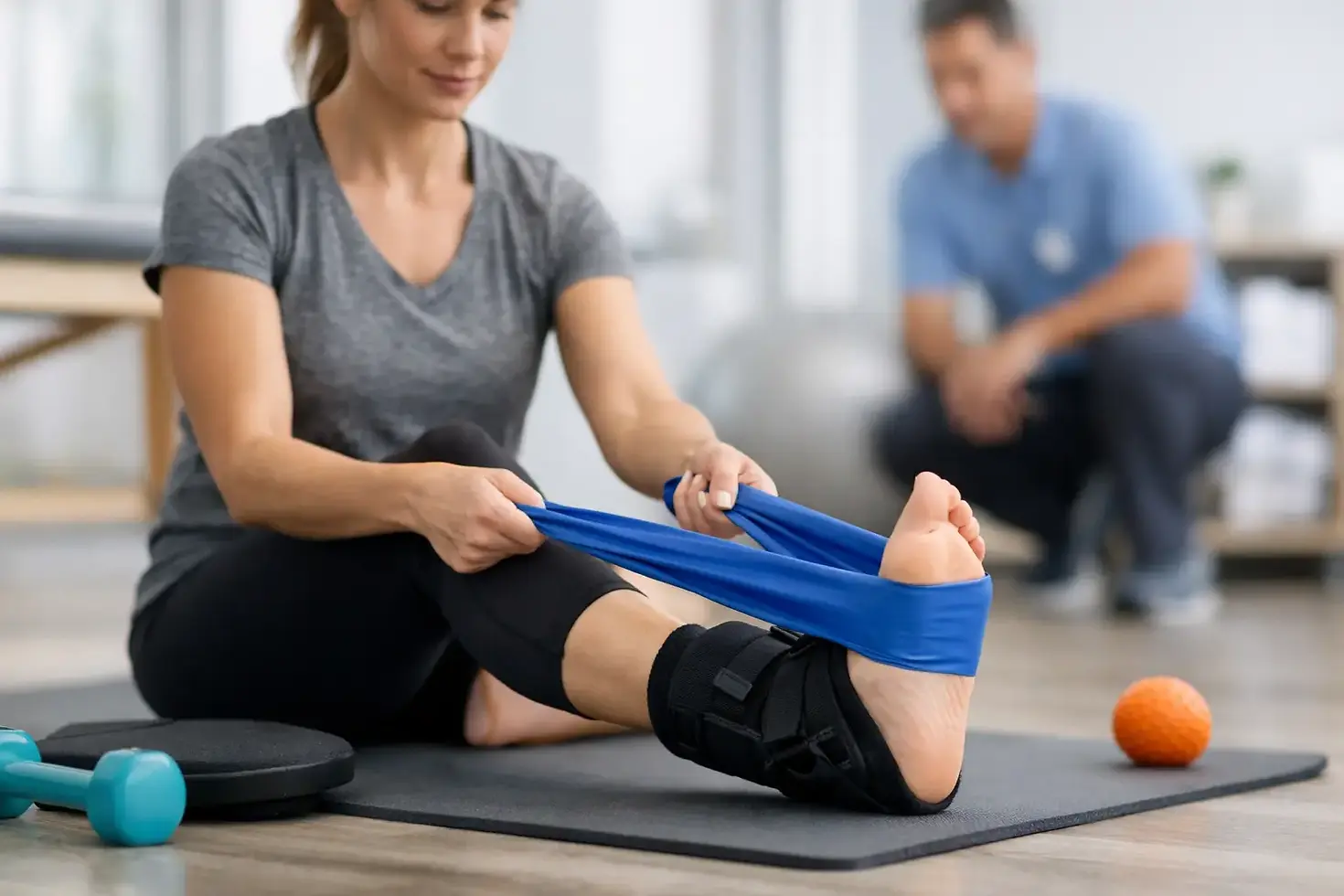
Resistance-band ankle movements
Use a light resistance band around the forefoot. Press the foot down against the band, then practise pulling the toes up. You can also move the foot inwards and outwards against resistance. Move slowly and keep the knee still.
Start with two sets of 10 to 15 repetitions in each comfortable direction. The outward movement may feel more challenging after a typical outside ankle sprain, so use a light band and focus on control rather than force. Build resistance gradually as symptoms settle.
Double-leg calf raises
Stand near a worktop or sturdy chair for support. Rise onto the balls of both feet, pause briefly, then lower with control. Begin with two sets of 10 repetitions.
When this is comfortable and your walking is normal, progress to calf raises mostly on the injured side, then eventually single-leg calf raises. Strong calves contribute to better push-off when walking and running, and help the ankle manage repeated loads.
Stage three: improve balance and ankle control
Ankle ligaments provide information to the brain about joint position. After a sprain, that information can be less reliable for a while. Balance exercises help retrain the body to react when the foot lands slightly off-centre.
Single-leg stand
Stand close to a kitchen worktop or wall. Lift the uninjured foot and balance on the recovering side for up to 30 seconds. Keep a soft bend in the knee and try not to grip the floor with your toes.
Repeat three times. Once this feels steady, make it harder by turning your head slowly, reaching with your hands, standing on a folded towel, or briefly closing your eyes. Only progress one element at a time and keep a support within reach.
Step-ups and controlled step-downs
Use a low step. Step up with the injured leg, straighten through the hip and knee, then step down slowly. As control improves, stand on the step and lower the opposite heel towards the floor before returning to the start position.
The knee should track roughly over the second toe rather than collapsing inwards. These movements are useful because they resemble the demands of stairs, kerbs and many sporting actions. Start with eight to 10 controlled repetitions on each side.
Stage four: prepare for running, work and sport
You should not rush into hopping or running simply because the swelling has gone down. Before higher-impact exercise, you should be able to walk briskly without pain or limping, complete controlled single-leg calf raises and balance confidently on the affected leg.
If these milestones are comfortable, begin small double-leg hops on the spot. Progress to single-leg hops, side-to-side hops and forward hops only when each earlier step feels stable. Keep the landing quiet, with the knee and foot aligned. For runners, a walk-jog plan is often a more sensible first step than returning immediately to normal mileage.
Sports involving cutting, jumping or contact place greater demands on the ankle. Football, netball, tennis and trail running may require direction-change drills, landing practice and sport-specific conditioning before a full return. An ankle brace or taping can provide short-term support for some people, but it should complement rehabilitation rather than replace it.
How often should you do ankle sprain rehabilitation?
Gentle mobility exercises can often be practised little and often, particularly in the early stage. Strength and balance work is usually more effective when completed three to four times a week, with rest between harder sessions. The exact frequency depends on your symptoms, current fitness and the total load on your ankle from work, walking and other exercise.
Recovery time varies. A mild sprain may settle in a few weeks, while a more significant ligament injury can take several months to regain full strength and confidence. Pain alone is not the only measure of recovery. An ankle that is pain-free but weak or unsteady still needs attention before you return to high-demand activity.
When personalised physiotherapy can help
If you are stuck with stiffness, swelling, weakness, repeated rolling or a fear of putting weight through the ankle, a tailored rehabilitation programme can make the next steps clearer. At Physio Rehab Clinic, treatment is built around your assessment, whether your priority is returning to the gym, getting through a long shift comfortably, or competing again with confidence.
A well-rehabilitated ankle should not just feel less painful. It should let you move with trust in your body again. Start at the level your ankle can manage today, progress steadily, and give each stage the time it needs to support the things you love doing.


Comments